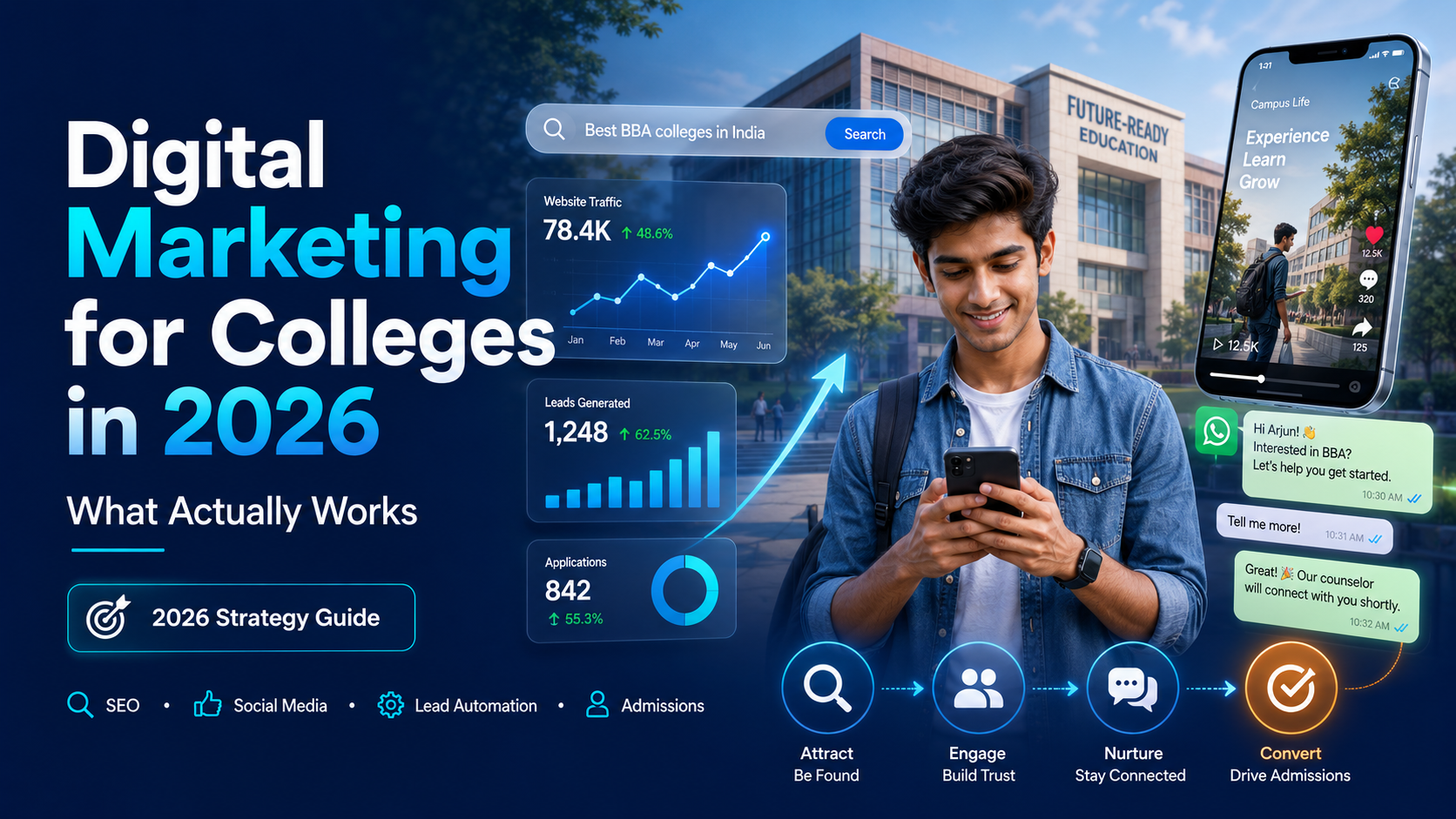
Running digital ads for a college is no longer about putting up a banner and hoping students apply. The competition has shifted — and so has the student. A 17-year-old exploring career options today is doing it on a phone, on Instagram Reels, on YouTube, and through Google searches at midnight.
If your institution is not showing up in those moments, someone else is. This is not about having a ‘digital presence.’ It is about having a system that attracts, engages, and converts prospective students into actual admissions.
Here are the six areas every college and educational institution must focus on in 2026 — and why each one matters more than the year before.
1. SEO-First Websites: Rank for What Students Are Actually Searching
Most college websites are designed to impress — colourful visuals, campus photos, bold taglines. But here is the problem: if your website does not rank on Google when a student searches ‘BBA colleges in Pune’ or ‘best engineering college in Rajasthan,’ all that design investment means nothing.
In 2026, an SEO-first approach means building your website around the exact terms your future students are typing in that search bar.
- Dedicated landing pages for each course and programme
- Fast loading speed — especially on mobile
- Optimised page titles, meta descriptions, and headings
- Blog content answering common admission queries
2. Mobile-Optimised Admission Journeys: Stop Losing Students on Small Screens
More than 70% of students in India browse colleges on their smartphones. If your admission form takes forever to load, has broken fields, or is just a desktop page squeezed into a phone screen — you are losing inquiries every single day.
Mobile optimisation goes beyond responsive design. It means:
- Short, simple inquiry forms — name, phone, course for the first step
- Click-to-call and click-to-WhatsApp buttons prominently visible
- Pages that load in under 3 seconds
- Easy navigation to fee structure, eligibility, and placement data
Every friction point in the mobile journey is a potential dropout. Fix those, and your inquiry volume improves without spending more on ads.
3. Trust-Building Content: Show, Don’t Just Tell
Students and parents are doing thorough research before making a decision. They want proof, not just promises. And trust is built through content — real, specific, verifiable content.
What actually builds trust online:
- Approvals and accreditations displayed clearly — NAAC, NBA, AICTE, UGC
- Actual placement stats with company names, not just percentage claims
- Faculty profiles with qualifications and industry experience
- Authentic campus photos and walkthrough videos
- Student and alumni testimonials — video format works best
| Generic stock photos and vague ‘industry-aligned curriculum’ language do not move the needle. Real, specific evidence does. |
4. Social Media Marketing: Build Presence Before Admission Season
Many institutions activate their social media only during admission season. That is like meeting someone for the first time and immediately asking them to sign a contract. It does not work.
Students follow pages, watch Reels, and engage with content months before they decide where to apply. Consistent presence on Instagram, YouTube, and LinkedIn builds brand familiarity — so when admission season arrives, your institution is already on their radar.
Content types that consistently perform well for education pages:
- ‘Day in the life’ student Reels or YouTube Shorts
- Faculty spotlights and brief lecture clips
- Campus event coverage and fest highlights
- Placement success stories — real names, real companies
- Admission guides and eligibility explainers
5. Lead Automation: Respond Faster, Convert More
Speed is everything in lead handling. If a student inquiry is not followed up within 5 minutes, the chance of conversion drops sharply. Most institutions respond hours later — sometimes not at all.
Automation tools — WhatsApp Business API, CRM systems, and email workflows — change this completely. When a student fills a form:
- An instant WhatsApp message goes out with brochure and next steps
- The lead is assigned to a counsellor automatically
- Follow-up reminders are scheduled without manual effort
Institutions that implement this consistently see better inquiry-to-enrollment ratios without hiring more counsellors.
6. Data-Driven Decisions: Track What Works, Cut What Doesn’t
Spending lakhs on Google Ads without knowing which campaign drove actual admissions is money going into a black hole. Data tracking puts you in control.
At a minimum, track:
- Which traffic source sends the most qualified leads
- Which course pages get visits but no form fills
- Where students drop off in the admission form
- Cost per inquiry broken down by campaign and channel
| With Google Analytics 4, Meta Pixel, and a CRM in place, this data is available in real time. Your marketing spend will keep getting smarter every season. |
Frequently Asked Questions
Q1. How much should a college spend on digital marketing in 2026?
Most institutions allocate 3–8% of expected admission revenue to marketing. Smaller colleges can start with focused SEO and social media before scaling to paid campaigns.
Q2. Which social media platform works best for college marketing in India?
Instagram and YouTube are strongest for reaching students aged 16–22. LinkedIn works well for postgraduate and professional courses. Use all three, but prioritise based on your course offerings.
Q3. Is WhatsApp marketing effective for college admissions?
Yes — WhatsApp has some of the highest open rates of any communication channel. Automated flows for instant inquiry responses, document sharing, and follow-ups significantly improve conversion rates.
Q4. How long does SEO take to show results for a college website?
Typically 3–6 months for measurable organic traffic growth. Starting SEO work at least 6 months before your main admission season is strongly recommended.
Q5. Can a small college compete with big universities in digital marketing?
Absolutely. Smaller institutions can win by going hyper-local — targeting city-specific or course-specific search terms where large universities are less focused. Authenticity and niche content give smaller colleges a genuine edge.
Conclusion
Digital marketing for colleges in 2026 is not about running a few ads during admission season. It is about building a system — one that attracts students year-round, answers their questions before they even ask, and earns trust before they step through your gate.
Institutions that combine strong SEO, mobile-first design, consistent content, and smart automation will consistently outperform those that rely on walk-ins and word of mouth. The ones that start now will lead the admissions race in the next three years.